SLIDE 001
LECTURE 03 · SEPTEMBER 15, 2026
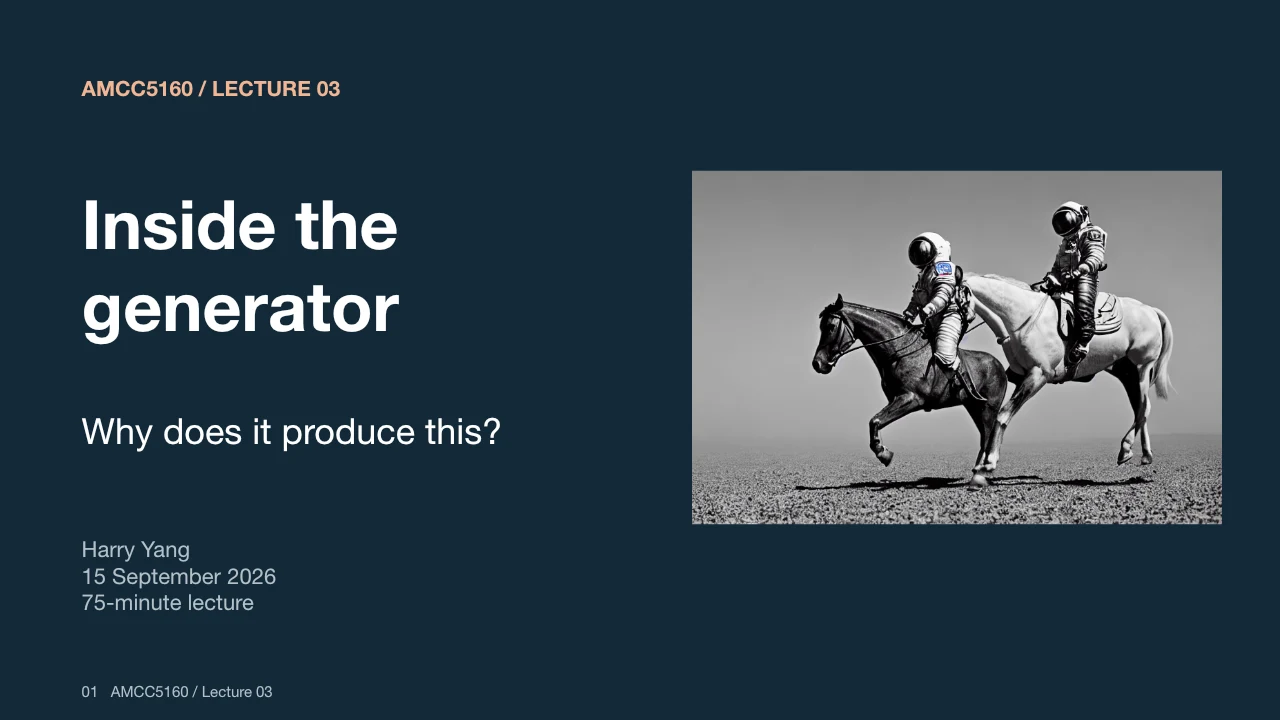
Inside the generator:
why does it produce this?
77-minute lecture · Slides · English / 中文 transcripts
WATCH THE LECTURE · ENGLISH / 中文
From noise to images, video, and actions.
Explore the lecture with English and Chinese captions. Use the chapters below to revisit a topic.
CLASS DISCUSSION
Explain what changes.
Use the slides to support your answer. Suggested answers are starting points for discussion.
Discussion: training or sampling?
- Training on a new image set: which values change?
- Generating with a new seed: which values change?
- Which action can change learned subject behavior?
Suggested answer
Training changes the model weights. A new seed changes random choices during generation; it usually leaves the weights fixed. Training or adaptation can change learned subject behavior.
Discussion 2: Does it match the instructions?
- Goal: yellow coat, red suitcase on the left, station roof on the right.
- list the details you would check.
- could the picture look good and still get these details wrong?
Suggested answer
Check the yellow coat, the red suitcase and its position, and the station roof on the right. A picture can have pleasing color and composition while placing an object incorrectly.
Discussion 3: Clear subject, wrong mood
- The coat is yellow, but the picture feels harsh and crowded.
- how would you compare guidance settings fairly?
- how would you judge the colors and mood?
Suggested answer
Compare the same seeds at several guidance values while keeping other settings fixed. Judge crowding, color saturation, lightness, and the intended mood across the grid.
Discussion: Design an experience that responds
- Imagine a visitor moves the red suitcase in our station scene.
- Should the system explain, predict a new scene, or move a real prop?
- What should happen if it misunderstands the visitor?
Suggested answer
Choose the output the experience needs: an explanation, a predicted scene, or a physical action. If it is uncertain about the visitor’s intention, the system should ask or stop before moving a real prop. Test both correct responses and misunderstandings.
Discussion 4: Compare the pictures
- Compare the pictures. Which differences seem related to the settings, and which might come from the seed?
Suggested answer
Compare matched seeds across settings. Judge the same visible features in each picture, including object placement, color, and composition. Use several seeds to see whether a difference is consistent.
Discussion 5: Choose a look for our scene
- choose a camera view and drawing style for our scene.
- explain your choice using two details in the pictures.
- name one change you would try next.
Suggested answer
Choose a view and style, then point to two visible details that support the choice, such as the suitcase silhouette and the separation between the visitor and the roof. Name one setting or local edit to change next.
Three questions before we finish
- Why can the same prompt give different pictures?
- Why might stronger guidance make the picture worse?
- What would you save so you can repeat a result?
Suggested answer
Different seeds produce different starting noise. Very strong guidance can damage color, detail, or variety. Save the prompt, negative prompt if used, model version, seed, sampler, step count, guidance, resolution, and any reference images or masks.
LECTURE 03 · THREE READINGS
Read, then question.
Two positions on AI safety and one practical image workflow. Choose one for your Quiz 03 reflection. Downloadable guides include questions and links to the original sources.
Reading 1
We Must Pace the Frontier ↗
Amodei argues that AI capability should advance slowly enough for safeguards to catch up. Consider his proposals for independent evaluation and coordination, and what evidence would justify slowing development.
Reading 2
open the frontier ↗
Dorsey argues for open releases and independent scrutiny, with narrow controls on specific risks. Compare his conditions for restricting publication with Amodei’s case for pacing development.
Reading 3
A controlled workflow for generating and editing images ↗
Plan a six-image comparison, record seeds and settings, then repair a bowl’s rim with a mask. Connect reproducibility, spatial control, and local editing to a concrete exhibition poster.
LECTURE RESOURCES
Download the complete lecture.
QUIZ 03 · 5 QUESTIONS · 20 POINTS
Connect technique
and intention.
Four questions on lecture content and one reading reflection. Due by semester end.