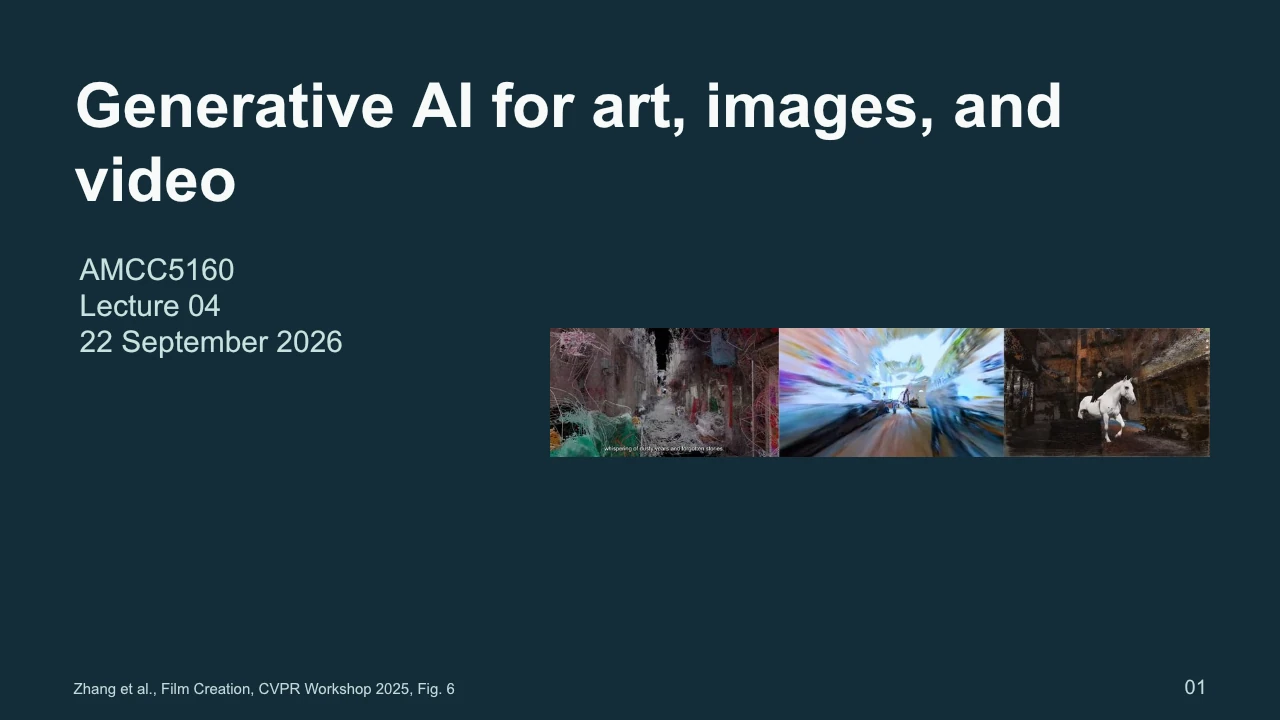
Lecture 04 · 22 September 2026
AI Video Generation
and Art Filmmaking.
From video generation models to artistic intention, filmmaking practice, and the choices that shape a finished work.
100 slides · 64-minute narrated lecture · English transcript / 中文讲解 · Three assigned readings · Five-question quiz
Two public AI perspectives + one technical reading
Three readings for this week.
Explore two widely discussed AI perspectives, then connect them to the video-generation ideas from class. For Quiz 04, reflect on any one of these three readings.
Reading 1 / Interview
Jensen Huang in conversation with Jo Ling Kent · CBS Sunday Morning | September 20, 2026
Watch the interview. Write down one claim you would like to discuss in class.
Questions to keep in mind
- What is the speaker's main position?
- Which reason do you find strongest or weakest?
- What evidence would help you evaluate that claim?
Practice separating a prediction from an observed result. Use the same habit when assessing claims about creative AI tools.
The interview aired on September 20; it circulated widely afterward. The interview is the assigned source, not a reproduced transcript.
Reading 2 / Popular AI essay
Sam Altman · June 2025 | Essay
Read the essay, focusing on creativity, work, and adaptation.
Altman presents an optimistic forecast in which AI increases productivity and makes more kinds of creation accessible. He also discusses safety, access, and social adjustment. Treat the dates and outcomes as the author's predictions, not established facts.
Questions to keep in mind
- What change does the author expect in creative work?
- Why might expertise still matter when tools become more accessible?
- Choose one prediction you agree or disagree with. Explain why.
Consider whether easier image and video generation removes the need for artistic judgment, or changes where that judgment is applied.
This is a public-facing opinion essay. Agreement with the author is not required.
Reading 3 / Technical reading
Yimu Wang et al. · 2026 revision | TMLR
Read the abstract, Section 2.1 (Video generative paradigms), Section 4.1 (Conditions), and Section 4.4 (Consistency). Skim the relevant figures; mathematical derivations are optional.
The survey organizes video-generation methods, input conditions, and applications. For this lecture, concentrate on how a video is specified and how its content remains coherent across frames.
Questions to keep in mind
- How does starting from an image differ from starting only with text?
- Name one thing that should remain consistent across frames.
- What might an attractive still frame fail to tell you about a video?
This reading directly supports the text-to-video, image-to-video, and temporal-consistency concepts in today's lecture.
You are not expected to memorize model names or equations.
Download the reading guide
The five survey papers cited in the slides remain the lecture sources. The three assignments above are this week's readings.