Review: Lectures 01–10.
A lecture-by-lecture review of Lectures 01–10, technical content first: the architectures, equations and numbers behind each lecture, with the original slides back on screen, plus the art and critique ideas you need for your final presentation. Every slide links back to the original slides it recaps.
74 slides · English script / 中文讲解 · Links to 195 slides from earlier lectures · An “Ask yourself” question on most slides · Five-question review quiz · After the break: the last weekly presentations
The Semester in One Evening
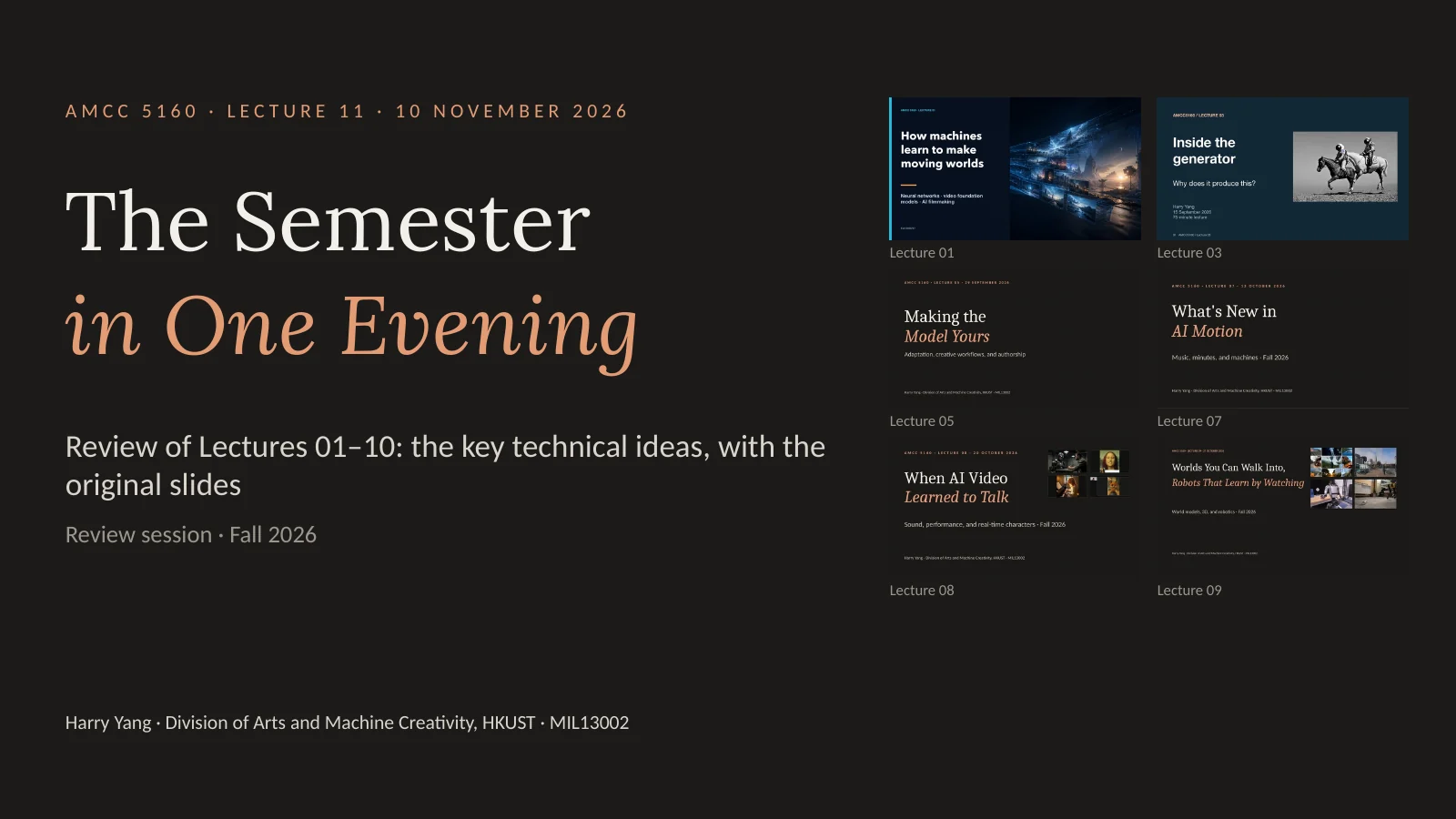
Script / 中文讲解
Use the arrow keys to move between slides. In the PowerPoint file, every small slide picture links to the original slide online.
Every earlier slide tonight points back to.
Grouped by lecture. Each link opens the original slide in its own lecture, with its script and Chinese explanation.
- ► L01 · 1 · How machines learn to make moving worlds
- ► L01 · 7 · A generated video is a learned prediction about change
- ► L01 · 8 · Every generator can be read through four stages
- ► L01 · 11 · Learning means reducing error across examples
- ► L01 · 16 · A convolution scans one learned filter across the image
- ► L01 · 26 · Queries ask; keys match; values contribute
- ► L01 · 29 · Attention alone does not know order
- ► L01 · 33 · An encoder and decoder negotiate a bottleneck
- ► L01 · 36 · Training creates many controlled corruption levels
- ► L01 · 43 · Time adds another expensive axis
- ► L01 · 44 · Compress space and time before the transformer
- ► L01 · 45 · A token can represent a small block of spacetime
- ► L01 · 46 · Full attention is powerful; sparse attention is practical
- ► L01 · 85 · Five gates prevent expensive confusion
- ► L01 · 86 · Define change before style
- ► L01 · 90 · Use the least generative task that solves the shot
- ► L01 · 95 · Change one variable after a known-good workflow runs
- ► L01 · 96 · Hold the shot constant; vary one decision
- ► L01 · 97 · Keep the usable interval, not the prettiest thumbnail
- ► L01 · 101 · Design one eight-second shot before opening a generator
- ► L01 · 102 · Technical literacy becomes creative agency
- ► L04 · 15 · Training data shapes the result
- ► L04 · 16 · A closer look at data filtering
- ► L07 · 9 · Why five seconds was the limit
- ► L02 · 1 · Generative Editing
- ► L02 · 9 · The edit contract
- ► L02 · 10 · An invariant can be semantic or exact
- ► L02 · 13 · A smaller workspace: image latents
- ► L02 · 17 · Inside a current image editor
- ► L02 · 18 · The missing target at inference
- ► L02 · 25 · Where edit supervision comes from
- ► L02 · 26 · What a mismatched training pair teaches
- ► L02 · 29 · Different controls carry different information
- ► L02 · 30 · ControlNet: add spatial conditioning
- ► L02 · 51 · Hokusai: scale, rhythm, and tension
- ► L02 · 52 · Reference as a relationship, not a label
- ► L02 · 54 · Negative space has a job
- ► L02 · 57 · Reference roles
- ► L02 · 62 · A lucky image or a reliable direction?
- ► L02 · 67 · A critique with observable evidence
- ► L02 · 70 · A process record makes critique more precise
- ► L02 · 76 · Consistency is not stillness
- ► L02 · 80 · Four good frames can hide a bad video
- ► L02 · 85 · 45 frames become 12: why?
- ► L02 · 94 · The frozen video wins the wrong test
- ► L02 · 98 · The moment the pear returns
- ► L02 · 115 · Separate image and text guidance
- ► L05 · 64 · Image Prompt Adapter (IP-Adapter)
- ► L01 · 26 · Queries ask; keys match; values contribute
- ► L03 · 1 · Inside the generator
- ► L03 · 13 · Clean image plus noise
- ► L03 · 21 · The model predicts. The sampler takes a step.
- ► L03 · 32 · How CLIP links pictures and words
- ► L03 · 33 · A similar-looking image can still be wrong
- ► L03 · 44 · Flow matching: learning how to move
- ► L03 · 48 · Different seeds can give different pictures
- ► L03 · 49 · How to repeat a result
- ► L03 · 51 · A character sheet defines what must stay
- ► L03 · 54 · A small guidance calculation
- ► L03 · 58 · Discussion 3: Clear subject, wrong mood
- ► L03 · 62 · A progress picture or a finished result?
- ► L03 · 63 · Generation cost: count model evaluations
- ► L03 · 64 · Some models need only a few steps
- ► L03 · 91 · How to make a fair comparison
- ► L03 · 94 · Reading a guidance grid
- ► L03 · 99 · University lectures behind this lesson
- ► L04 · 12 · Spatial attention and temporal attention
- ► L05 · 34 · Only fine-tune cross-attention layers
- ► L07 · 22 · Test it yourself: does she come back the same?
- ► L09 · 19 · Under the hood: why the world must come back the same
- ► L04 · 1 · Generative AI for art, images, and video
- ► L04 · 9 · A video has two kinds of time
- ► L04 · 12 · Spatial attention and temporal attention
- ► L04 · 15 · Training data shapes the result
- ► L04 · 16 · A closer look at data filtering
- ► L04 · 20 · Motion and camera control
- ► L04 · 37 · The artist’s intention comes first
- ► L04 · 43 · Content and style need separate decisions
- ► L04 · 44 · A technical score answers a narrow question
- ► L04 · 49 · One intention, one intervention
- ► L04 · 56 · What filmmakers wanted
- ► L04 · 58 · Overthinking
- ► L04 · 61 · Clown
- ► L04 · 64 · For Pixi
- ► L04 · 66 · Fish Tank
- ► L04 · 68 · Volumography
- ► L04 · 70 · A short film still needs decisions
- ► L04 · 98 · Quality has several meanings
- ► L04 · 99 · A process others can understand
- ► L02 · 35 · LoRA: low-rank adaptation
- ► L05 · 1 · Making the Model Yours
- ► L05 · 3 · Whose model is it?
- ► L05 · 7 · Text-to-image isn't perfect: the moongate
- ► L05 · 10 · Unseen contexts
- ► L05 · 11 · No knowledge of personal concepts
- ► L05 · 12 · Customization: V* dog
- ► L05 · 27 · DreamBooth vs. Textual Inversion
- ► L05 · 28 · Memorized training images
- ► L05 · 30 · Memorized style
- ► L05 · 34 · Only fine-tune cross-attention layers
- ► L05 · 35 · How to prevent overfitting?
- ► L05 · 45 · Concept ablation: the goal
- ► L05 · 54 · Ablating Greg Rutkowski (1)
- ► L05 · 61 · Low-rank adaptation (LoRA)
- ► L05 · 71 · Danger and ethical concerns: PULSE (1)
- ► L05 · 74 · The truncation trick reduces diversity
- ► L05 · 75 · Bias in text-to-image models
- ► L05 · 76 · Quick fixes or long-term solutions?
- ► L05 · 78 · Whose model is it — now?
- ► L07 · 1 · What's New in AI Motion
- ► L07 · 7 · The unit of AI video is now the scene
- ► L07 · 9 · Why five seconds was the limit
- ► L07 · 10 · Two ways to make a long video
- ► L07 · 15 · Under the hood: the KV cache
- ► L07 · 16 · Helios: a minute of video, in real time
- ► L07 · 18 · Under the hood: distillation, from 50 steps to 3
- ► L07 · 31 · Wan-Dancer: song in, dance out
- ► L07 · 34 · The trick: plan the song, then the steps
- ► L07 · 36 · What the model has to hear
- ► L07 · 43 · Who is the choreographer here?
- ► L07 · 47 · Four steps from phone to robot
- ► L07 · 49 · Why not just copy the pose?
- ► L07 · 52 · The sim-to-real gap
- ► L07 · 54 · Why dance challenges are perfect training data
- ► L07 · 59 · Eighteen months as a product
- ► L07 · 65 · A project folder that survives
- ► L07 · 66 · Useful: pin your versions
- ► L05 · 67 · Smaller changes, fewer steps, smaller numbers
- ► L07 · 15 · Under the hood: the KV cache
- ► L08 · 1 · When AI Video Learned to Talk
- ► L08 · 6 · Synchresis: why sound is half the picture
- ► L08 · 19 · Inside LTX-2: two streams, one clock
- ► L08 · 21 · Keeping time: why positions must be aligned
- ► L08 · 26 · Data: finding clips that are really in sync
- ► L08 · 39 · What is a performance made of?
- ► L08 · 41 · Sounds you can see: phonemes → visemes
- ► L08 · 43 · Under the hood: how we measure lip-sync (SyncNet)
- ► L08 · 44 · Reading the scoreboard (and its trap)
- ► L08 · 47 · How VASA-1 works: generate motion, not pixels
- ► L08 · 51 · OmniHuman-1.5: a planner thinks, a renderer acts
- ► L08 · 57 · Directing the delivery: what to ask for
- ► L08 · 62 · Two numbers that define “real time”
- ► L08 · 64 · Why a normal video diffusion model can’t talk back
- ► L08 · 65 · Three tricks you already know
- ► L08 · 71 · Avatar Forcing: an avatar that listens (CVPR 2026)
- ► L08 · 78 · The real filter funnel, and what it keeps
- ► L08 · 85 · Tilly Norwood: an “actress” who never existed
- ► L08 · 88 · What the actors won: the 2026 SAG-AFTRA contract
- ► L08 · 90 · Your voice is part of your identity
- ► L08 · 92 · Two flashpoints from this year
- ► L03 · 85 · World models: test a round trip
- ► L07 · 21 · Under the hood: the train-test gap
- ► L08 · 47 · How VASA-1 works: generate motion, not pixels
- ► L09 · 1 · Worlds You Can Walk Into, Robots That Learn by Watching
- ► L09 · 8 · What is a world model?
- ► L09 · 11 · Genie 3: a world that waits for you
- ► L09 · 13 · Waymo World Model: Genie 3 learns to drive
- ► L09 · 15 · Under the hood: one extra input
- ► L09 · 16 · Under the hood: where do the actions come from?
- ► L09 · 17 · Genie at play time: three parts in a loop
- ► L09 · 19 · Under the hood: why the world must come back the same
- ► L09 · 27 · Pixels or geometry? Two ways to make a world
- ► L09 · 33 · Under the hood: from a scene to a function (NeRF)
- ► L09 · 34 · Under the hood: only put stuff where stuff is
- ► L09 · 37 · The result: from 0.07 to 100+ frames per second
- ► L09 · 40 · This autumn, splats became a normal file format
- ► L09 · 46 · Under the hood: what is inside a VLA?
- ► L09 · 48 · Under the hood: small mistakes compound
- ► L09 · 50 · λ0 (26 Oct 2026): a humanoid that learned from people
- ► L09 · 51 · HumanVerse: wear the robot’s eyes
- ► L09 · 53 · λ0, by the numbers
- ► L09 · 59 · Under the hood: why copying plateaus around 80%
- ► L09 · 65 · Two camps
- ► L09 · 66 · NVIDIA Cosmos 3: one open model to reason, simulate and act
- ► L09 · 68 · Why not pixels? JEPA predicts the meaning, not the picture
- ► L09 · 69 · V-JEPA 2-AC: plan a robot move without drawing the future
- ► L02 · 94 · The frozen video wins the wrong test
- ► L04 · 44 · A technical score answers a narrow question
- ► L05 · 16 · Ongoing legal battles (1)
- ► L08 · 44 · Reading the scoreboard (and its trap)
- ► L08 · 88 · What the actors won: the 2026 SAG-AFTRA contract
- ► L10 · 1 · Is It Any Good? Looking at, measuring, showing and signing AI art
- ► L10 · 3 · Now you know: it won a prize, then it was refused copyright
- ► L10 · 9 · 1859: Baudelaire hated photography. Then he sat for Nadar.
- ► L10 · 10 · 1917: the first prompt engineer? “He CHOSE it.”
- ► L10 · 11 · A month ago: the Pope and an artist, in public
- ► L10 · 12 · Slop: the word of 2025, and what its opposite is
- ► L10 · 13 · The most useful slide tonight: four questions people mix up
- ► L10 · 17 · See. Think. Wonder.
- ► L10 · 18 · A critic’s four steps, on a work you know: Edmond de Belamy
- ► L10 · 20 · How to read an AI image: four questions to add to your crit
- ► L10 · 28 · What pixels say: moving 8 pixels is worse than wrecking it
- ► L10 · 31 · Worked example: the copycat gets a perfect score
- ► L10 · 34 · VBench: stop giving one number. Give sixteen.
- ► L10 · 40 · We ran that predictor on art history this afternoon
- ► L10 · 48 · Dataland: “the world’s first museum of AI arts”
- ► L10 · 51 · Madison, 18 September: a museum, Beeple, and a curtain
- ► L10 · 53 · Two layers of consent, and the museum answered one
- ► L10 · 55 · Same word, “generative”. Different decisions.
- ► L10 · 64 · Under the hood: three layers, three different promises
- ► L10 · 65 · Under the hood: C2PA in four steps
- ► L10 · 66 · See it: the real manifest we signed this afternoon
- ► L10 · 67 · We broke it four ways, in Python, in five minutes
- ► L10 · 68 · Under the hood: the watermark. A hidden message, tested.
- ► L10 · 73 · Useful: a credit block you can copy for A2 and A3
- ► L10 · 80 · Generating is now cheap. Looking, deciding, and signing your name are not.
- ► L01 · 101 · Design one eight-second shot before opening a generator
- ► L01 · 102 · Technical literacy becomes creative agency
- ► L10 · 73 · Useful: a credit block you can copy for A2 and A3
- ► L10 · 80 · Generating is now cheap. Looking, deciding, and signing your name are not.
- ► L10 · 81 · Crit sheet: copy this for your final presentation
Ten lectures, one line each.
Use this as a checklist before your final presentation. If you can explain each line with an example from your own work, you are ready. The links go to the three slides that carry each lecture's main idea.
- Lecture 01 · Sep 1Neural networks to AI filmmaking
A generated video is a learned prediction about change. Read any generator as data → representation → model → sampling.
- Lecture 02 · Sep 8Generative editing
Write the edit contract (change, keep, adapt). Choose a control by the information that is missing. A video edit must survive the next frame.
- Lecture 03 · Sep 15Inside the generator
The model predicts; the sampler takes a step. Seed, guidance and steps are different knobs; guidance extrapolates.
- Lecture 04 · Sep 22Video generation and art filmmaking
Frame time is not denoising time. Data filtering shapes what a model can make. The artist’s intention comes first.
- Lecture 05 · Sep 29Making the model yours
Textual Inversion, DreamBooth, Custom Diffusion, LoRA, IP-Adapter: what is trained? Memorization and concept ablation. Whose model is it?
- Lecture 06 · Oct 6Quantization for faster model inference (TA talk)
Yaofu Liu’s TA talk: quantization stores each number in fewer bits, so the same GPU does more per millisecond.
- Lecture 07 · Oct 13Music, minutes, and machines
The unit of AI video became the scene. Autoregressive generation, KV cache, distillation, drift and Self Forcing. Keep your sources; pin your versions.
- Lecture 08 · Oct 20AI video that talks
Synchresis. Two streams, one clock. Lip-sync and its scoreboard trap. Real-time budgets. Consent and the performer.
- Lecture 09 · Oct 27Worlds, 3D, and robots
A world model adds an action. Pixels or geometry (Gaussian splats). VLAs, compounding errors, and practice beyond copying.
- Lecture 10 · Nov 3Is it any good?
Four questions: AI? good? fair? allowed? What scores can and cannot see. Consent has layers. C2PA, watermarks, and the credit block.
Review the technical core.
Four technique questions and one reflection, drawn from across the semester. Write one to three sentences for each.
Open Quiz 11 →Submit online using the course access code and your student ID. You can retrieve and edit your submission before the semester-end deadline.
Review, diagnose, plan.
- Every lecture opens with its original title slide, the question it asked, and what it covered.
- Most slides end with an “Ask yourself” question. Answer them for your own project.
- Diagnose four real symptoms: which knob, or no knob at all? (slides 24–25)
- Turn the six course outcomes into six slides of your final presentation. (slide 72)
- After the break: the last weekly presentations.